
Different Types of 12-Bar Progressions
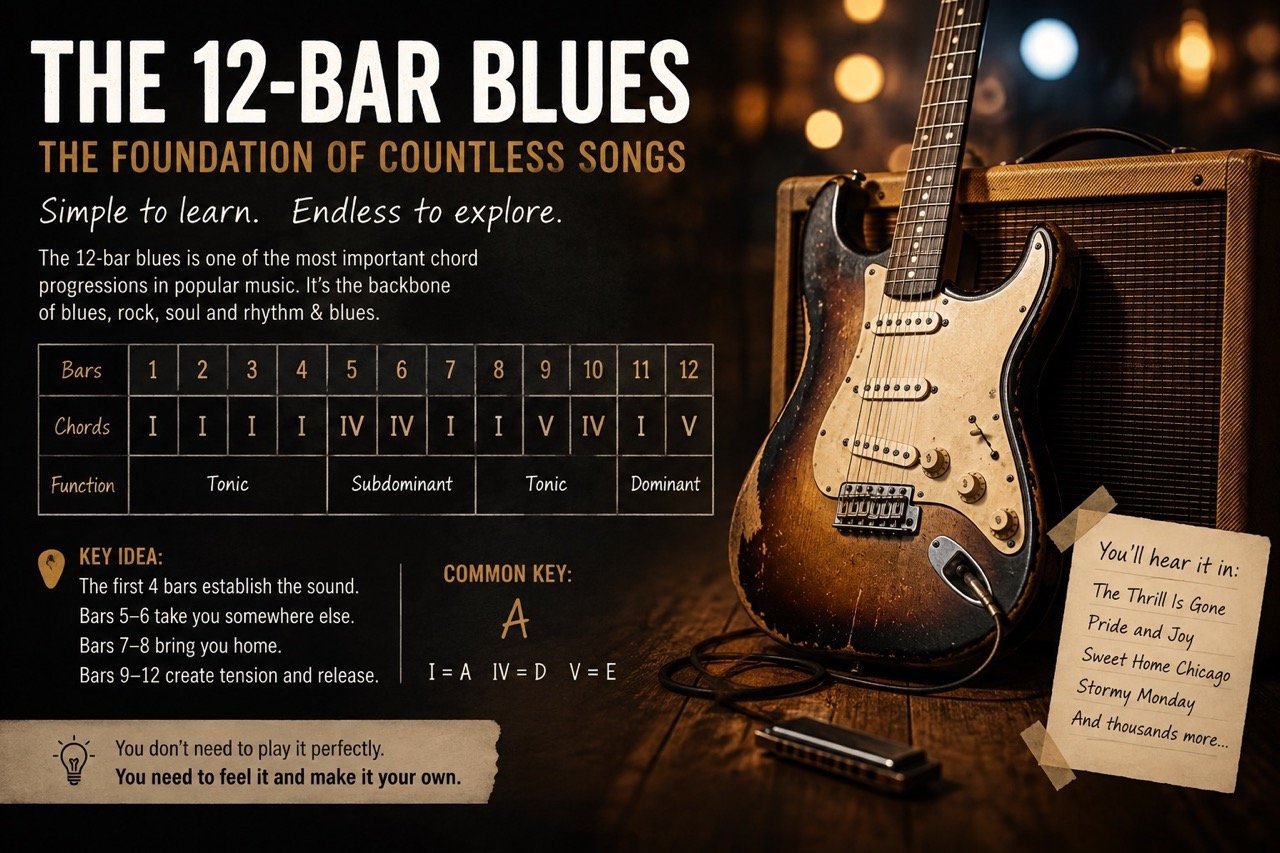
he 12-bar blues is the backbone of most blues jams, and its reach goes well beyond blues into rock and roll, R&B, soul, country and jazz.
It is familiar for a reason. If the band knows the form, you can call a key, count it in, and have a tune on its feet with very little discussion. That is one of the great strengths of blues language: it gives musicians a shared map.
Caveat, because there is always a caveat: not all 12-bars are the same.
Think of the 12-bar as a framework rather than one fixed progression. The number of bars gives you the shape, but the harmony inside that shape can change. A standard blues, a quick-change blues, a minor blues and a jazz blues may all be 12 bars long, but they do not ask the band to think or listen in exactly the same way.
For a jammer, that matters. If you assume every 12-bar is the same, you will eventually play straight through a change the rest of the band was expecting you to hear. This is character-building, but avoidable.
The Standard 12-Bar
The standard 12-bar uses three main chords: the I, IV and V.
In the key of A, the three main dominant chords are A7, D7 and E7. In Roman numerals, those are I7, IV7 and V7.
The standard 12-bar shape is:
I7 | I7 | I7 | I7
IV7 | IV7 | I7 | I7
V7 | IV7 | I7 | V7
In A, that becomes:
A7 | A7 | A7 | A7
D7 | D7 | A7 | A7
E7 | D7 | A7 | E7
If one sequence from this article sticks with you, make it this one. Practise it in C if you want the clearest theory view, then move it to A, G and E, because those keys turn up constantly at jams.
Get to know the sound of the changes, not just the names. You should be able to feel bar 5 arriving before anyone tells you. You should hear bar 9 turn the corner. You should know when bar 12 is setting up the next chorus.
That is when the form starts becoming music rather than paperwork. I’ve heard so many songs where the 12-bar format still sounds fresh because of what is happening and how it is delivered.
The Blues Jam Handbook
Standard 12-Bar
Notes:
1) Bars 11 and 12 are often called the turnaround.
2) Some players also refer to bars 9-12 as the turnaround section.
3) This V7-IV7-I7-V7 ending is one of the most useful versions to learn first.
The Quick Change
A quick change means the progression moves to the IV chord in bar 2, then returns to the I chord in bar 3.
The form is usually:
I | IV | I | I
IV | IV | I | I
V | IV | I | V
In A:
A | D | A | A
D | D | A | A
E | D | A | E
This is common in slow blues because sitting on the I chord for four full bars can feel a little bare at slower tempos. The quick change gives the first line some movement.
The trap is missing bar 2. If the singer or guitarist calls “quick change” and you stay on the I chord, everyone will know immediately. The good news is that you only have to be wrong for one bar, which is merciful.
The Blues Jam Handbook
12-Bar Quick Change
Notes:
1) The quick change is the move to IV7 in bar 2.
2) This is especially common in slower blues, where four full bars of I7 can feel too static.
3) Bars 9-12 are often treated as the turnaround section.
The Minor Blues
A minor blues changes the emotional temperature immediately.
Instead of dominant or major-flavoured I, IV and V chords, the basic version uses minor chords:
Im | Im | Im | Im
IVm | IVm | Im | Im
Vm | IVm | Im | Vm
In A minor:
Am | Am | Am | Am
Dm | Dm | Am | Am
Em | Dm | Am | Em
That is the plain version. In real playing, you will often hear stronger substitutions, especially in bars 9, 10 and 12.
For example:
Am | Am | Am | Am
Dm | Dm | Am | Am
F7 | E7 | Am | E7
That F7 in bar 9 is the bVI dominant. It has a dark, dramatic pull, and it is one of the sounds people associate with tunes like “The Thrill Is Gone”, although that tune has its own specific feel and should not be treated as a generic minor blues.
The V7 chord, E7 in the key of A minor, gives the turnaround a stronger pull back to the tonic than Em. This is one of those places where theory and feel shake hands politely.
The Blues Jam Handbook
Minor Blues
Notes:
1) The plain version uses Am, Dm and Em.
2) F7 in bar 9 is the bVI7 chord. It gives the final line a darker, more dramatic pull.
3) E7 can replace Em in bars 10 or 12 for a stronger pull back to Am.
The Jazz Blues
A jazz blues keeps the 12-bar frame but adds more harmonic movement.
A basic jazz blues in C might look like this:
C7 | F7 | C7 | Gm7 / C7
F7 | F#dim7 | C7 | Am7
Dm7 | G7 | C7 / Am7 | Dm7 / G7
The important thing is not to panic at the extra chords. A jazz blues is still a blues form, but with more passing movement, secondary dominants, ii-V progressions and substitutions.
Bars 9 and 10 are the giveaway for many players:
Dm7 | G7
That is a ii-V in C, and it gives the final line a stronger sense of harmonic direction.
If you are soloing, you do not have to outline every chord like you are filling in a tax form. But you do need to know the road is moving under you. The better you hear the movement, the more relaxed your playing becomes.
The Blues Jam Handbook
Jazz Blues
Notes:
1) Split bars show two chords sharing the bar evenly.
2) Bar 4 uses Gm7 then C7 to lead into F7 in bar 5.
3) Bar 6 uses F#dim7 as a passing diminished chord.
4) Bars 9 and 10 form a ii-V in C: Dm7 to G7.
5) A7 in bar 8 gives a stronger pull into Dm7 in bar 9.
Why This Matters At A Jam
When someone says “12-bar”, they are not always giving you enough information.
They might mean a standard blues. They might mean a quick change. They might mean a minor blues. They might mean a jazz blues. They might mean a song that has 12-bar DNA but has been rearranged by every band that has ever touched it.
So listen for the first chorus. Watch the player who called the tune. Notice whether bar 2 changes. Notice what happens at bar 9. Notice whether the turnaround is plain, minor, dominant, or jazzier.
The form is your safety net, but your ears are still in charge.
JW Pro Tip
Practise these forms in more than one key, but do not stop at writing them down.
Play them slowly, sing the roots, and learn to hear bar 5 and bar 9 before they arrive. At a jam, the player who hears the form coming will always sound more confident than the player who is counting for dear life.
