
What Is A Train Beat?
What Is A Train Beat?
“Give it a train beat.”
At a blues jam, a train beat usually means a rolling rhythm that suggests wheels on a track: steady, driving, clipped and full of forward motion. It is not just “play fast”. It is the sound of the song moving down the line with purpose, not falling down the stairs.
You will hear it in blues, country, rockabilly, roots music and anything that wants that chugging, travelling pulse. At a jam, the instruction is mainly for the drummer, but the whole band has to understand it. If the drummer is the train, the rest of us should probably avoid standing across the tracks.
The Groove Has To Keep Moving
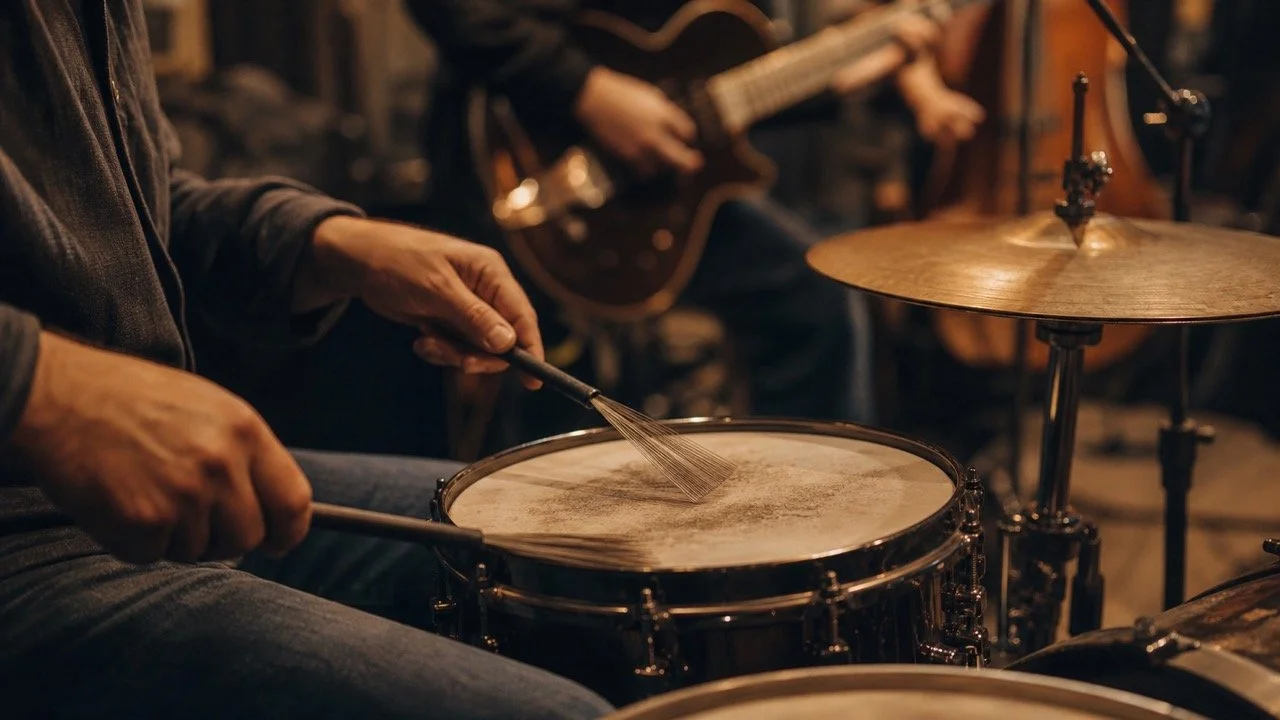
A train beat often has a busy snare pattern, sometimes with brushes, sometimes with sticks, with the accents giving the feel its motion. The kick drum and bass part help decide whether it feels light and skipping, heavy and driving, or somewhere in between.
The important word is “rolling”.
The beat should feel constant without becoming frantic. A good train beat gives the singer something to ride on. A bad one feels like everyone is late for something.
For guitar players, this means your rhythm part needs to lock into the motion rather than decorate every bar. Short muted figures, clipped chords and little low-string pulses can work beautifully. Long ringing chords can turn to porridge if the rhythm section is already busy.
A Little Bit Of Trivia
The train rhythm turns up all over American roots music. Trains were part of the sound world and the story world: movement, escape, work, distance, trouble, all the useful cheerful stuff.
Johnny Cash is one of the clearest references for many players. His records often used that steady, chugging pulse where the rhythm feels simple until you try to make it sit properly. Folsom Prison Blues is the obvious doorway.
Blues players may also think of Little Junior Parker - Mystery Train, first cut for Sun Records in the 1950s. It is not a drum lesson in the modern sense, but it carries that hypnotic train idea: repeated motion, tension and release, and a groove that does not need much explaining once you feel it.
What To Watch Out For
First, do not rush. This is the big one. A train beat has motion, but the tempo still belongs to the song. If the first verse feels exciting and the third verse feels like cardio, something has gone wrong.
Second, do not fight the snare. If the drummer is already giving you a busy rolling pattern, the guitar does not need to chatter over the top of it. Find the gaps. They are your friends, even if they look lonely.
Third, keep the bass simple enough to support the engine. A clever bass line that keeps stepping on the snare pattern can make the whole band feel tangled.
Fourth, watch the singer. Train beats can make a song feel as if it wants to run away. The singer’s phrasing will tell you whether the groove is helping or bullying.
For another rhythm reference, see What Is a Texas Shuffle?. For the full series, go to The Blues Jam Handbook.
Essential Listening
Johnny Cash - Folsom Prison Blues
Listen to the chugging pulse and how little clutter there is. The rhythm creates movement, but the vocal still sits right in front.
Little Junior Parker - Mystery Train
Listen to the repeated feel underneath the vocal. The power is in the insistence, not in anyone trying to be impressive.
JW Pro Tip
If a train beat starts to feel exciting, check your tempo before you enjoy yourself too much.
The best version rolls. The worst version bolts.
Sources
Johnny Cash Official Site - At Folsom Prison
