
What Do Musicians Mean By Chicago Blues?
What Do Musicians Mean By Chicago Blues?
“Can we do this more Chicago?”
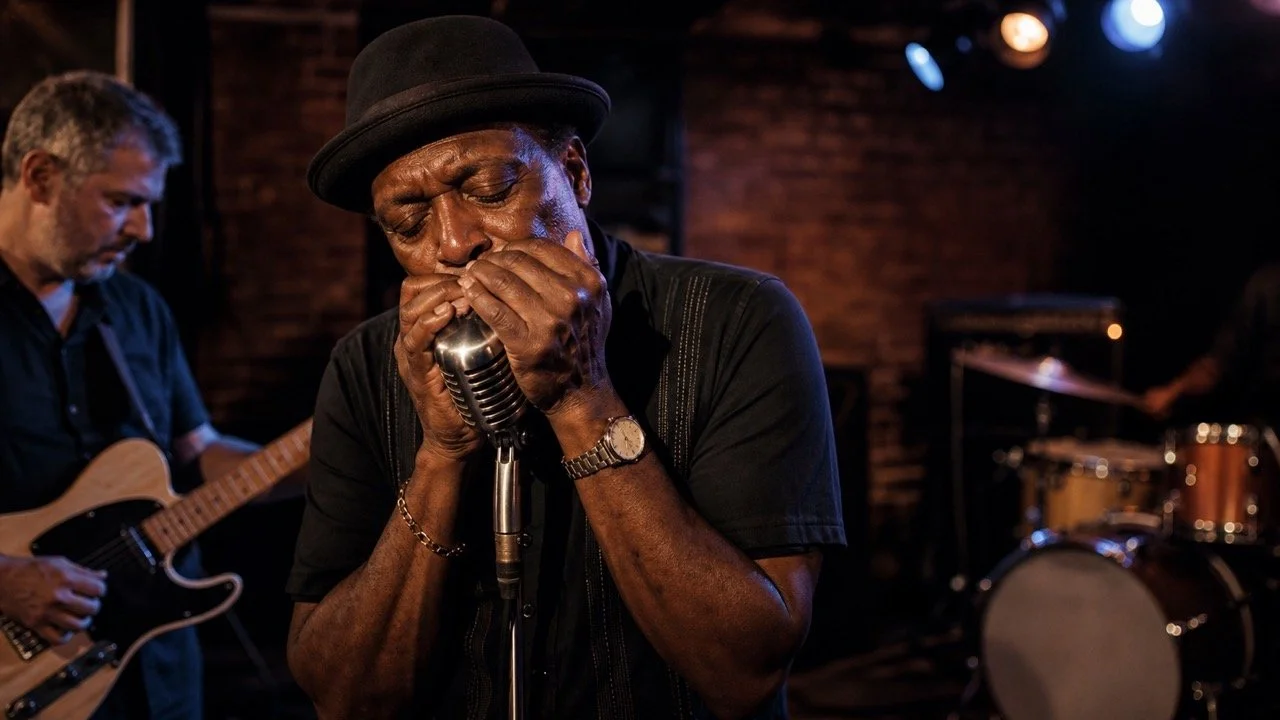
At a blues jam, Chicago blues usually means amplified band blues: strong vocal, electric guitar, harmonica or piano if you have it, bass and drums all working together with a tougher urban sound. Not necessarily faster. Not necessarily louder, although somebody will usually try that first.
Think less front-porch guitar, more small club with a band squeezed into the corner and everyone having to mean it.
The danger is that players hear “Chicago” and immediately reach for volume. That is not the point. Chicago blues has weight, bite and authority, but the best versions still leave space. The groove should feel like a band, not five people proving they own equipment.
The Sound Is A Band Sound
Chicago blues is often what happens when older blues language gets plugged in and surrounded by a rhythm section.
The guitar is important, of course, but it is not the whole story. The harmonica can drive the arrangement. The piano might thump away with little rolling figures. The bass might sit on a repeated line rather than walking all over the shop. The drums need to make the song feel dangerous without turning it into a pub rock charge.
If you are the guitarist, your job is not automatically to fill every spare inch. A little answering phrase after the vocal can be perfect. A short chord stab in the right place can sound enormous. A solo is lovely when it arrives, but rhythm guitar is where you prove you are listening.
A Little Bit Of Trivia
Chicago blues grew out of migration, electricity and city life. Musicians brought blues language north from places such as Mississippi and reshaped it for louder rooms, bigger bands and electric instruments.
The National Park Service describes Chicago blues in the 1940s as an amplified electric style rooted in Mississippi Delta blues and shaped by urban life. Muddy Waters is often placed right at the centre of that story, along with players around him such as Little Walter, Jimmy Rogers, Otis Spann and Willie Dixon.
That is useful history, but on a bandstand the message is simpler: make it sound like a tough electric blues band, not an acoustic tune that has accidentally found a drummer.
What To Watch Out For
First, do not overplay behind the singer. Chicago blues vocals often need room for attitude, timing and little conversational gaps. If you keep answering every line like an excited relative, the song gets crowded quickly.
Second, listen for the harp. If there is a harmonica player, they may be carrying a major part of the sound. Guitarists who fight the harp usually lose, and deserve to.
Third, keep the rhythm part clean. Muddy, Jimmy Rogers and all those Chess-era players were not throwing giant modern chord shapes at everything. Small parts, repeated figures and good tone will get you much closer.
Fourth, watch the dynamics. Chicago blues can be raw, but it should still breathe. The band needs somewhere to go when the solo starts or the singer digs in.
For a related groove reference, see What Is a Texas Shuffle?. For the full series, go to The Blues Jam Handbook.
Essential Listening
Muddy Waters - Hoochie Coochie Man
Listen to the stop-start weight of the arrangement. The band does not need to play constantly to sound powerful. In fact, the gaps are part of the threat.
Listen to how the harmonica sits right at the front without the band falling apart underneath it. The rhythm section keeps the floor solid, and that is why the harp can fly.
JW Pro Tip
If someone calls for Chicago blues, turn your guitar volume down slightly before you start and clean up the tone.
That sounds backwards, but it makes you listen harder. If the band locks in, you can always bring the heat up. If everyone starts too loud, the song has nowhere useful to go.
